~ musings on feeling, sensing, breathing, moving & being ~
Hatha Yoga as a pathway to healing the mind
“In modern intellectual terms, we take buddhi to be a monolithic entity. This is unhelpful when trying to understand its true role in our lives and in our yogic practice. Let us first separate it from “mind”, whose function is to receive sensory information to think and to act.
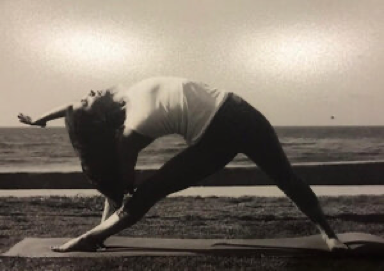
Utthita Trikonasana, San Diego, 2005
Intellect is more subtle than mind, it is concerned with the knowledge of facts and reasoning faculties, and becomes discernible only through its inherent quality, intelligence, which is closer to consciousness than to the mind/thought process. Intelligence is inherent in every aspect of our being from the physical to the blissful. It is, however, non-manifest in the atman/purusa: the core of being.
The quality of intelligence is inherent but dormant [to humans] so our first step must be to awaken it. The practice of asana brings intelligence to the surface of the cellular body through stretching, and to the physiological body by maintaining the pose. Once awakened, intelligence can reveal its dynamic aspect: its ability to discriminate. Then we strive for equal extensions to achieve a balanced, stable pose; measuring upper arm stretch against lower, right leg against left, inner against outer, etc. This precise, thorough process of measuring and discriminating is the apprenticeship or culturing of intelligence; and it is pursued in the internal sheaths by pranayama, pratyahara, and the further stages of yoga.
We can thus see that discrimination is a weighing process belonging to the world of duality. When what is wrong is discarded, what is left must be correct.
When discrimination has been cultivated and intelligence is full and bright, ego and mind retreat, and *citta* becomes bright and clear. But spiritual intelligence, which is true wisdom, dawns only when discrimination ends. Wisdom does not function in duality. It perceives only oneness. It does not discard the wrong, it sees only the right. Wisdom is not mingled with nature and is indeed unsuitable for the problems of life in a dualistic world. It would be of no use to a politician, for example, however high his motives, for he must choose and decide in the relative and temporal world. Spiritual wisdom does not decide, it *knows*. It is beyond time.
However, the progressive refinement of intelligence is essential in the search for freedom. The discriminating intellect should be used to “defuse” [digest, metabolize, circulate, or ameliorate] the negative impact of memory, which links us in psychological time to the world of sensory pleasure and pain.
All matter, from rocks to human cells, contains its own inherent intelligence, but only man has the capacity to awaken, culture, and finally transcend intelligence. Just as the totally pure *citta*, free from sensory entanglements gravitates towards the atman, so, once intelligence has achieved the highest knowledge of nature, it is drawn inwards towards the soul (4.26). Buddhi has the capacity to perceive itself: its innate virtue is honesty (1.49)”
~ BKS Iyengar,
Light on the Yoga Sutras of Patanjali,
Commentary on sutra 1.7

The 4 Elements of an Alchemical Practice and Life

Beloved Yogis,
Do you ever get on your mat with the desire to have a grounding and blissful experience, but instead end up being held hostage by a restless mind that just wont let you be?
I recently read that the majority of our thoughts are simply recycled from a limited repertoire that we return to again and again. Research shows that most of the time we are simply thinking the exact same thoughts we’ve had for the majority of our lives, over-and-over-and-over-again.
How can we lean into our yoga practice as a vehicle for real transformation? These are the 4 core elements I have found to be the alchemical special sauce that yoga rests upon:
1) Concentration / Breath Awareness and Pranayama:
While on your mat, for the entirety of your yoga practice, keep your mind focused on breath awareness and patiently concentrate on the depth and duration of each breath. In general, longer exhales lead to deeper inhales, which is a useful thing to know.
2) Stay close to the inner longing for (or feeling of) devotion and love.
Feel your longing to return to the inner abode and home of Truth. Connect to source within you and stay close. Let source flow through your body and allow yourself to be with Source/Love, for the duration of your practice.
3) Persevere.
Keep at it, keep returning to your mat, to your breath, to your longing/aspiration, and to class.
4) Surrender.
Understand that satisfying the whims of your ego and small/temporary self will not bring you lasting happiness, peace, or reconciliation with your karmic debt and liberatory possibility.
In love and perseverance right there with you,
In the frustrations of bondage
and the bliss of practice,
Natasha S.

The Health of our Spirit
Beloved yogis:
I had the pleasure of speaking to the Kinesiology students of Vancouver Island University this past week on the health of the human spirit through the lens of yoga. One of the topics we talked about was on how ailments of the human spirit such as anxiety, depression, difficulty concentrating, sleep difficulty, feelings of discontent or disconnect, loneliness - are some of the main concerns of yoga, and that the technology, lineages, and practices of yoga are designed to address exactly this.
Yoga is comprised of a set of specific techniques of the body-heart-spirit-mind that bring clarity and vitality to the mind, release of tension and blockages in the body, expand and deepen respiratory capacity, all of which have an enormous impact on our mental health, moods, and feelings of what's possible and accessible in our lives.
Some of these yogic tools/technologies are:
Pranayama: building breath and energetic agency.
Asana: Yoga postures to strengthen, balance and tonify the body, organ systems, tissues and entire physiology, while healing the mind.
Drishti: Gazing point practices.
Mantra: healing, protective and reparative to the mind and spirit.
Mudra: meditative hand gestures that activate specific circuitries and energies in the body.
Dharana: a compendium of concentration practices and techniques.
Ananda: Bliss, sacredness, and joy cultivation.
Bhakti and Prema: the active cultivation of love and devotion
Seva: the attitude of service, the active participation in bringing greater wellness, possibility and happiness to our world. Service to the Divine presence in all as a way to heal ourselves from the tenacious claws of of greed, lack mentality, selfishness, ego-driven-behaviors and attitudes, unbalanced emotions, sleepyness, and more.
I hope you are inspired to return to your practice soon. As always, please reach out if you would like support in moving towards your healing and wellbeing through the practice of yoga.
The Healer and the Wounded need each other.

Who benefits when one helps another heal?
Who benefits when someone awakens to their innate power and potential?
We each have a measure of strength and how we direct it can make all the difference in the world.
✨ Widen your lens ✨
Have you ever had anyone *profoundly* help you, with ZERO strings attached? The kind of soul bond that is created is OUT OF THIS WORLD. No spellwork, manipulation, or trickery is needed for that kind of bond. True loyalty arises inherently, and it’s called... love.
Healing is communal, it’s not isolated, compartmentalized, individual or divisive.
And in the end when all is said and done, who did the real healing and who was the true needy?
✨ Return ✨
Let self-cultivation become your agenda, let the delight of seeing others become more clear, strong, bright, nourish you. There is fulfillment and inner peace derived from this.
Let go of manipulation and relocate your true North. Watch your real power grow.
Witness your soul grow roots into everything and everyone you are a part of. Witness it go to places you never could imagine, in free bodies that you will never own. Witness it light up miracles everywhere. Witness it extend past the limits of Y O U.
You are not controlling anymore, you are strengthening, untangling, encouraging, allowing. Then the light you give can only grow and expand you, not deplete you.