Lessons from Flowers

flowers.png

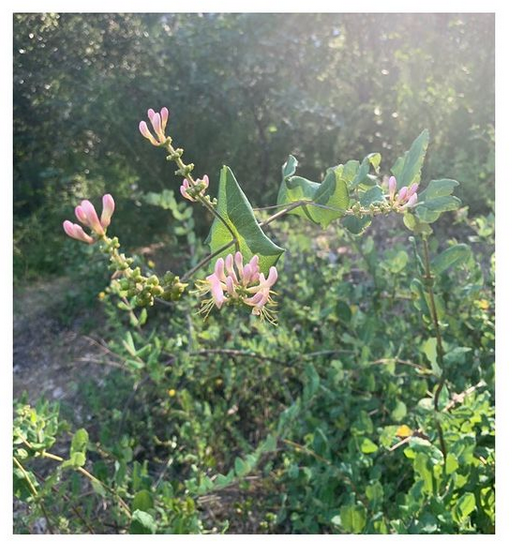
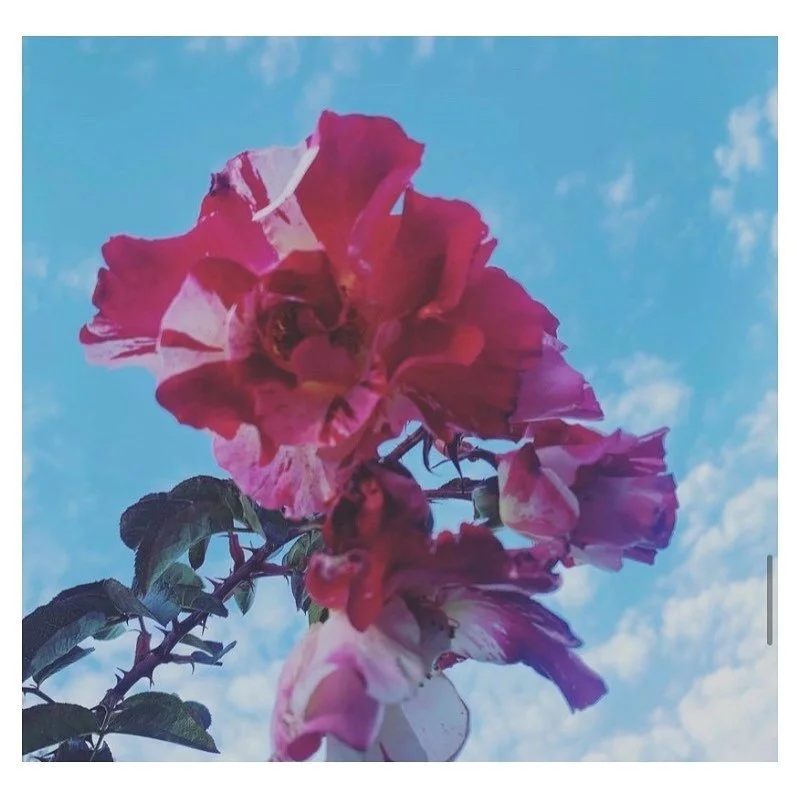
We can learn a lot from flowers
rooted yet unbothered,
Offering their sweetest nectar,
no questions asked
Here to simply make this world a little more honest, a little more light, and a little more sweet

🌸

Softness.

As I read the daily briefings from the NYT that arrive in my inbox: soften.

As I reflect on the tapestry of my own complex nature: soften.

As 2020 draws towards a close with major eclipses, excruciating loss, pain, compression, and uncertainty heightened in the collective nervous system: soften.

Impending environmental collapse: soften.

So much judgement and finger-pointing, from within and without, everywhere we look: soften.

”What does accountability, interconnection, and sustainability mean within the landscape of my own consciousness?” is a question that teaches, changes and orients me.

How do these function within a fractal world in which I will never know the full picture, yet my mere existence has unfathomable impact?

soften.

As I watch the shifting tectonics of my own struggles, fears, griefs, hopes, wounds, work, reactivities, self-forgiveness, coursing through my body day-in and day-out like the ocean tides or the cyclical phases of the moon:

tension / awareness/ release / tension / awareness /release / tension / unconsciousness/ more tension / crash / tension / struggle / revelation / eventual change / struggle / release.

Both oppressed and freed by the infinite layers of the self: soften.


🌸
Turning Towards our Original Nature

peonies.png

“Caught up in a mass of abstractions, our attention hypnotized by a host of technologies that only reflect us back to ourselves, it is all too easy for us to forget our carnal inheritance in a more-than-human matrix of sensations and sensibilities.

Our bodies have formed themselves in delicate reciprocity with the manifold textures, sounds, and shapes of an animate earth – our eyes have evolved in subtle interaction with other eyes, as our ears are attuned by their very structure to the howling of wolves and the honking of geese.

To shut ourselves off from these other voices, to continue by our lifestyles to condemn these other sensibilities to the oblivion of extinction, is to rob our own senses of their integrity, and to rob our minds of their coherence. We are human only in contact, and conviviality, with what is not human.”

- David Abram, The Spell of the Sensuous, Perception and Language in a More-Than-Human World

Light on Pranayama

Excerpts from Light on Pranayama by BKS Iyengar:

“When the breath is steady or unsteady, so is the mind, and with it, the yogi.
Hence, the breath should be honored” -
Hatha Yoga Pradipika Ch 11.2

art by Erzbet s

“The tree of life is said to have its roots above and its branches below, and so it is with man, for his nervous system has its roots in the brain.

The spinal chord is the trunk descending through the spinal column, while the nerves run down from the brain into the spinal cord and branch off throughout the body.

The arteries, veins and nerves are channels for circulating and distributing energy throughout the body. The body is trained by practicing yoga postures, which keep the channels free from obstruction. Energy does not radiate throughout the body if the channels are choked with impurities.

If the nerves are entangled, it is impossible to remain steady, and if steadiness cannot be achieved, the practice of pranayama is not possible. If the nadis are disturbed, one’s true nature and the essence of things cannot be discovered.

The practice of asanas [yoga postures] strengthens the nervous system, and the practice of savasana soothes ruffled nerves. If the nerves collapse, so does the mind. If the nerves are tense, so is the mind. Unless the mind is relaxed, silent and receptive, pranayama cannot be practiced.

[…] The practice of pranayama should not be mechanical. The brain and the mind should be kept alert, to hold the body in correct position and the flow of breath from moment to moment. One cannot practice pranayama by force of will; hence, there should be no regimentation. Receptivity of the mind and intellect are essential.

In pranayama the relationship between chitta (mind, intellect and ego) and breath is like that between a mother and her child. As a mother cherishes her child with love, care and sacrifice, citta should cherish prana

~ BKS Iyengar, Light on Pranayama

The fourth pathway to transformation: Trauma

image credit: Ivana Cajina

image credit: Ivana Cajina

Excerpt from the book “Healing Trauma” by Peter A. Levine: A pioneering program for restoring the wisdom of your body.

“Trauma is the fourth pathway to awakening. In transforming and releasing ourselves from trauma we must face, as does the newborn child, an uncertain world. It is a world stripped of the illusion of safety, and it obliges us to learn an entirely new way of being. When we enter it, we soon discover that our instinctive energies are not limited to acts of flight or uncontrolled violence [or freeze]. They are our heroic energies, and they can be harnessed. The energies that are released when we heal from trauma are the wellspring of our creative, artistic, and poetic sensibilities, and they can be summoned to propel us into the wholeness of our intelligence.

Trauma is about thwarted instincts. Instincts, by definition, are always in the present, and when we allow them their rightful domain, we surrender to the eternal now. With the full presence of mind and body, we can gain access to the source of our own energy and enthusiasm. […] As we resolve our traumas, we discover missing parts of our being, those that make us feel whole and complete. Our instincts house the simple but vital knowledge that “I am I”, and “I am here”.

Without this sense of belonging in the world, we are lost, disconnected from life. If we learn how to surrender to our inborn knowledge, it can lead us on a healing journey that will bring us face to face with our natural spirituality, our God-given connection to Life”